Where Is The Best Place To See Christmas Lights In NYC?
The best Christmas lights in New York are in Dyker Heights, Brooklyn, on free residential streets that outscale anything in Manhattan. This guide compares every lit spot, the costs, the subway routes, and the tours.
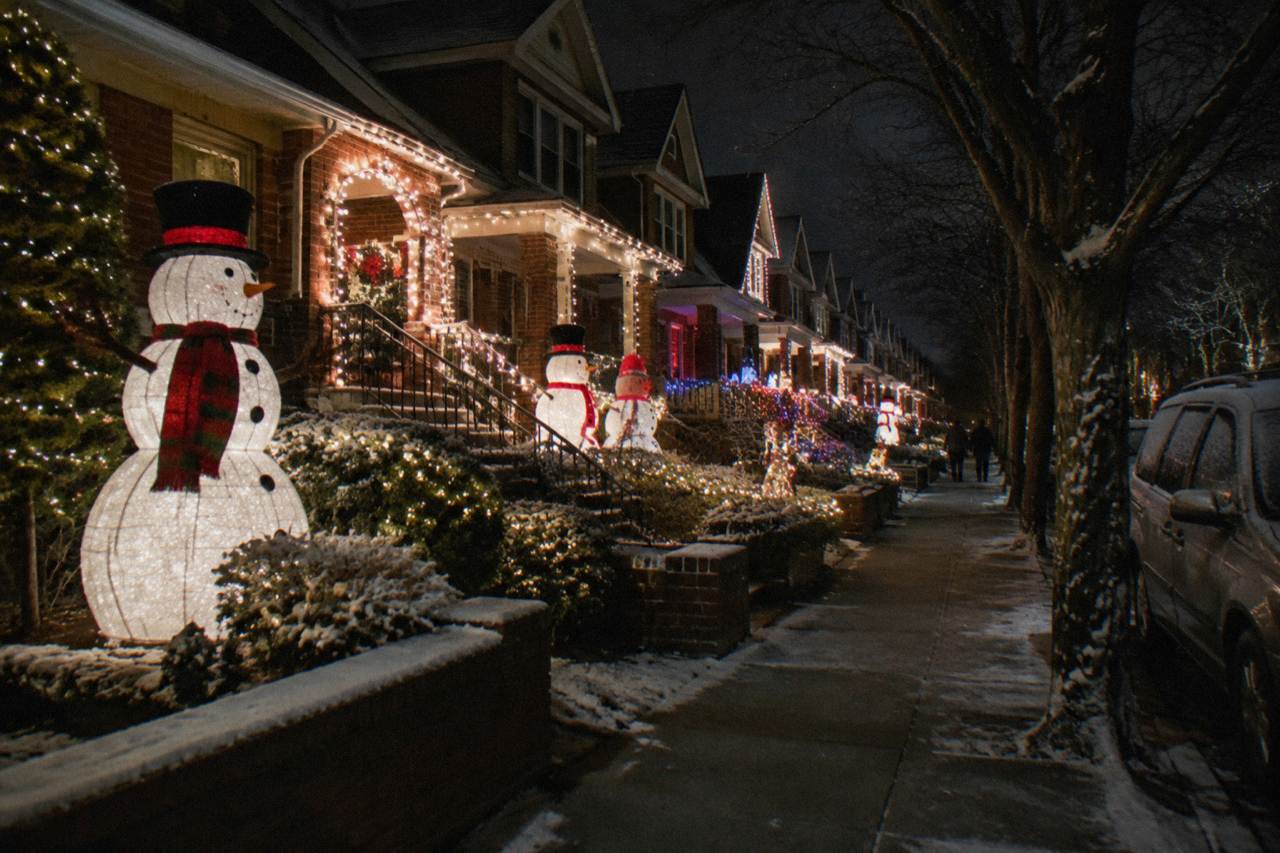
The densest wall of Christmas lights in New York City is not in Midtown. It stands on residential blocks in Dyker Heights, Brooklyn, decorated by homeowners rather than by any festival producer, and the core of it runs roughly from 83rd to 86th Streets between 10th/11th Avenues and 13th Avenue. Walking those sidewalks costs nothing. No gates, no tickets, no queue. By mid-December, arches of bulbs span the porches, oversized holiday figures crowd the lawns, and whole facades sit behind curtains of light that hold up against the cold. If you'd rather not walk the cold blocks on your own, our honest ranking of NYC's bookable Christmas lights tours compares the guided options that cover Dyker Heights.
Manhattan keeps the postcard. The Rockefeller Center tree gets the national broadcast, Bryant Park runs an entire lit village beneath the office towers, and Fifth Avenue dresses itself for the season. But when the question is where the lights themselves are, block after block, the honest answer leaves the island (see Is NYC Worth It?). This page lays out the full comparison: every major lit spot in the city, what each one costs to view, when the switches flip, and whether a guided tour earns its price over driving yourself into a parking problem.
Where Is It Best To See Christmas Lights?
Dyker Heights in Brooklyn is the best place to see Christmas lights in NYC. The free residential displays between roughly 83rd and 86th Streets outscale anything in Manhattan, and they run from late November into early January. Midtown's Rockefeller tree and Bryant Park are more famous, but for sheer density of lights, Dyker Heights wins. Since Dyker Heights sits far from the subway, a comparison of holiday lights bus tours can help you reach the displays without a long ride from Midtown.
The case is arithmetic as much as aesthetics. Rockefeller Center gives you one spectacular object, viewed from a plaza you share with thousands of other people. Dyker Heights gives you street after street of competing houses, spread across a walkable residential grid where the crowd thins out a block from the main drags. One is an icon. The other is an atmosphere, and it lasts longer: the Brooklyn displays typically stay up into the first week of January, some through January 6, while the tree comes down in mid-January and the Midtown markets close on Christmas Eve or shortly after.
That ranking is the throughline of Christmas In New York Activities, and it survives scrutiny. The Manhattan options are concentrated, walkable and free, which makes them ideal for a spare hour between other plans. Dyker Heights is a destination. It asks for a subway ride, a plan and a weeknight evening, and it pays that back with the most concentrated stretch of holiday lighting in the city, on public streets that charge no admission.
Here is the field at a glance, with the viewing costs and the windows each spot typically holds.
| Place | Where | What You See | Cost to View | Typical Window |
|---|---|---|---|---|
| Dyker Heights | Brooklyn, core near 83rd to 86th St | Block after block of homeowner displays | Free | Late Nov into early Jan |
| Rockefeller Center tree | Midtown, Rockefeller Plaza | A 60-100 ft Norway spruce above the rink | Free | Early Dec lighting, lit nightly to mid-January |
| Bryant Park Winter Village | Midtown, Bryant Park | Lit market stalls, The Lodge, the rink | Free entry, skating paid | Oct 28, 2026 through Feb 28, 2027 |
| Central Park South | Midtown, park perimeter | Street and park-edge lights along the carriage route | Free to walk | Nov-Dec |
"Best" still depends on the evening you actually have. A family with young kids and two spare hours before bedtime will get more from the Midtown loop, because the tree, the windows and the market sit within walking distance of each other. Anyone with a full evening and a tolerance for the subway should spend it in Brooklyn. The rest of this page works through both lanes, then settles the tour-versus-self-guided question with real numbers.
Why Does Dyker Heights Beat Every Manhattan Display?
Dyker Heights wins on scale and on price. The displays are built by homeowners on public residential streets, so walking them costs nothing, and the densest blocks sit between roughly 83rd and 86th Streets off 10th, 11th and 13th Avenues. Manhattan's tree is one spectacular object; Dyker Heights is whole streets of them.
The neighborhood's display grew out of a residential tradition, not a city program, and that origin explains most of what visitors find surprising. There is no operator, no official opening night and no master schedule. Each homeowner sets an own start and end date, which in practice clusters tightly: displays typically begin the weekend after Thanksgiving and stay lit through Christmas, often into the first week of January. The practical consequence is that the season is longer and more forgiving than Midtown's, and the stretch between Christmas and New Year's still looks close to full while the crowds thin.
Price is the other quiet advantage. Because the streets are public and the decorations are private gifts to the block, a self-guided visit costs exactly one subway fare. Nothing in Manhattan is expensive to view either, but Manhattan's free things come with density: the tree plaza at peak hours is a shoulder-to-shoulder experience on a sealed-off street. Dyker Heights spreads its crowd across a grid, and a block or two off the core the sidewalks feel almost local again.
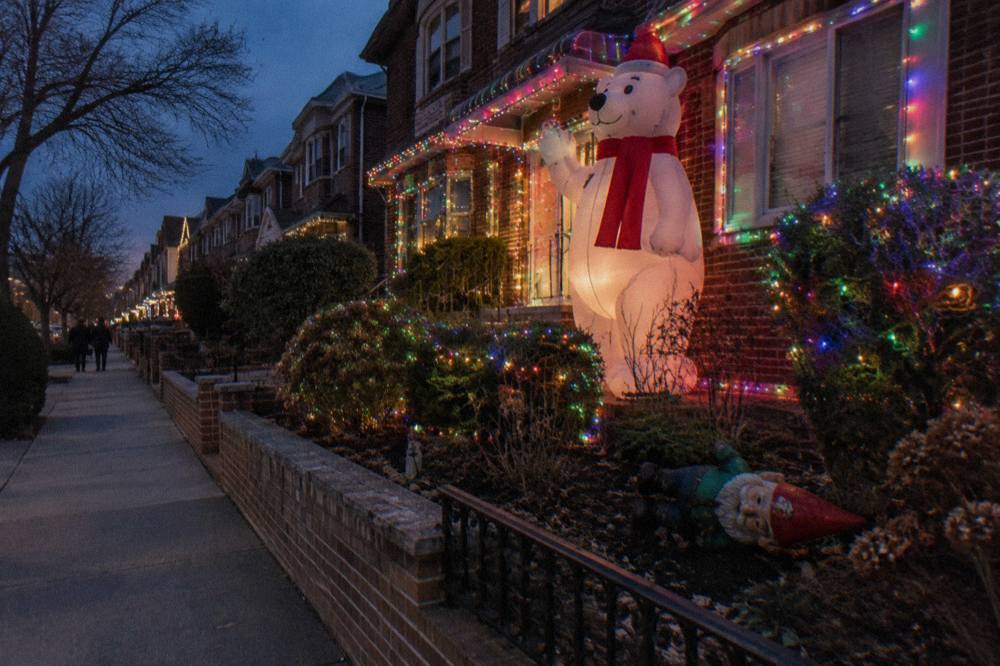
The look of the place is its own argument. Expect multi-story light arrays wired straight onto the facades, motorized sleighs, choir-speaker music, and giant inflatable figures that would dwarf a front yard anywhere else. Some houses run their displays on timers and sound systems that would shame a small municipal event. Neighbors quietly compete, and the visitor is the beneficiary. The etiquette is simple in exchange: keep voices down after dark, stay on the sidewalks, and do not block driveways, because every one of these houses is somebody's home.
The one genuine trade is logistics. Dyker Heights sits deep in Brooklyn, the December dark comes early, and the displays switch off around 9 p.m., which leaves little slack for transit mistakes. That is the gap guided products exist to fill. The "Dyker Heights Lights on Foot" walking tour, covered in full below, meets in Midtown and handles the subway leg with a flag-holding guide, which removes the only real friction in an otherwise free evening.
None of this diminishes Midtown. It simply separates two different products: one neighborhood that goes all in on lights as a contest between neighbors, and one district that stages a smaller number of flawless, professionally maintained scenes. If lights are the point, Brooklyn is the answer. If spectacle plus skating plus shopping in a single walk is the point, Midtown earns its billing, and the later sections of this page cover it properly.
How Do You Get From Manhattan To Dyker Heights?
Take the D train to 79th Street or the R to 86th Street, then walk 10 to 15 minutes to the display core between roughly 83rd and 86th Streets. Driving is discouraged: evening traffic is heavy and street parking is competitive. A guided bus removes both problems, with hotel pickup from $45.
The subway is the standard route, and the two stations bracket the display from opposite ends. The R train's 86th Street station and the D train's 79th Street station both sit a 10 to 15 minute walk, sometimes longer at a strolling pace, from the core blocks between 10th/11th and 13th Avenues. Which line you pick depends on where in Manhattan you start; both run frequently in the evening. Local reporting, including the Brooklyn Paper's annual Dyker Heights guide, treats those two stations as the default access points, and that advice held through the most recent season coverage.
Driving is the option local guides consistently warn against. Evening traffic around the residential streets backs up badly in December, and street parking near the displays is limited and competitive enough that circling can eat the better part of an hour you meant to spend looking at lights. No 2026-specific road closures or parking restrictions have been announced, but the general pattern is reason enough on its own to leave the car, or never rent one for this errand.
| Method | Route | Time and Notes |
|---|---|---|
| Subway | R train to 86th Street | 10-15+ minute walk to the core blocks |
| Subway | D train to 79th Street | 10-15+ minute walk to the core blocks |
| Car | Street parking near the displays | Discouraged: heavy evening traffic, competitive parking |
| Guided bus | Hotel pickup, Midtown departure | 4 hours, returns to the Times Square area |
Timing matters on the way back as much as on the way out. Because many displays go dark around 9 p.m., the return crowd surges in a narrow band, and rideshare prices in the area reflect that. Catching a train before the 9 p.m. switch-off, or planning a warm-up stop a few blocks from the core, spreads the evening out. For the full walkthrough, including what to watch for on the walk from the station, see the guide to getting from Manhattan to Dyker Heights.
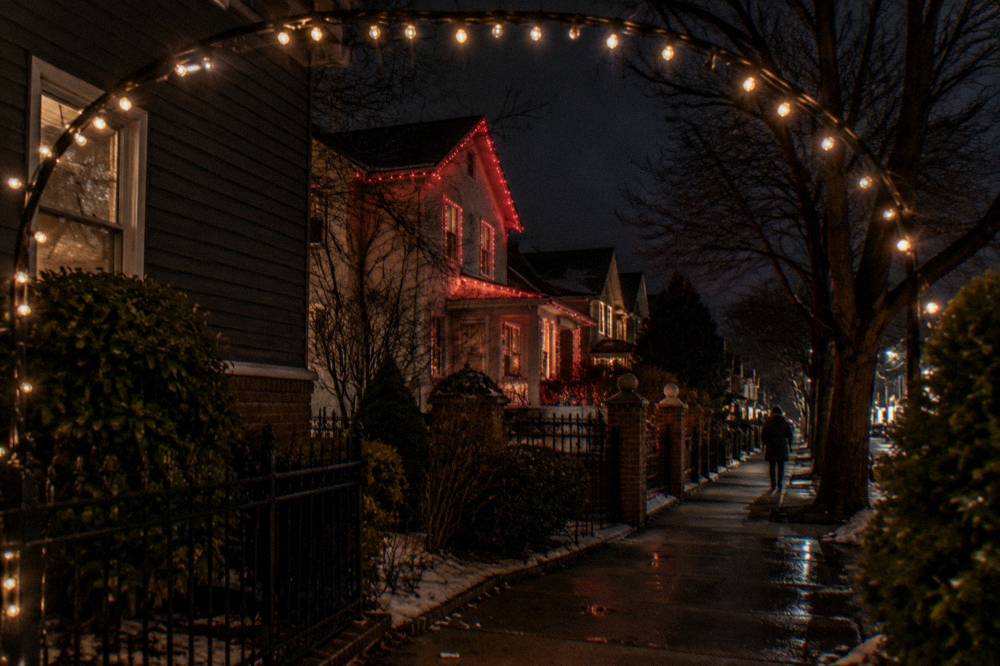
The transit math is exactly where guided tours earn their keep. A bus product handles the drive, the parking and the return in one price, which is why this site's recommendation leans toward tours over self-guided driving for anyone not confident on the subway at night.
Should You Take A Tour Or Walk Dyker Heights Yourself?
Walk it yourself and Dyker Heights is free; the trade is a subway ride at night and no one to explain the neighborhood. Guided options run from $45 for a 4-hour bus with hotel pickup to $399 for a private tour for up to six. For most visitors, a tour beats self-driving.
The self-guided version deserves its due before the numbers. You pay a subway fare each way, you set your own pace, and you can leave when the cold wins. What you give up is context, the comfort of a leader on the evening ride out, and any help when the blocks all start to look alike. Plenty of confident riders do it exactly that way, and the neighborhood asks nothing of them.
The guided ladder starts lower in price than most people expect. The "4-Hour Bus Tour, Hotel Pickup" runs from $45, includes hotel pickup, departs from the McDonald's at 1651 Broadway (W 51st St & Broadway), and returns to the Times Square area, with commentary in English and Spanish. It rates 4.4 from 670 reviews, the largest review pool of any Dyker product on this site, and the listing notes it is often booked same-day, which tells you the practical booking window. Four hours sounds long for a lights look, but the span covers pickup, the drive out, the walk through the core and the return, which is roughly what the same evening costs you unpaid in planning and transit fuss.
Above the bus sits a private option. The "Private Lights Tour With Pickup" runs from $399 per group of up to six travelers, lasts 4 hours, and collects you from any NYC location, which makes it a different animal: a family car service with a route attached. It rates 5.0, though from only 5 reviews, a small sample that says more about novelty than track record, and the listing notes 10 or more bookings in the past month.
The walking middle path is this site's featured pick. Full details are on the Dyker Heights Lights on Foot tour page, and you can Check availability for your dates. That tour runs from $69, rates 4.7 from 40 reviews, operates December 1 through January 3, and leaves duration details to the live listing. It meets at a small square near a cafe close to Rockefeller Center, where a guide holding a flag leads the group onto the subway and out to the lights, then handles the return. Every product in this comparison allows free cancellation up to 24 hours before the start.
| Tour | Price From | Rating and Reviews | Duration | Logistics |
|---|---|---|---|---|
| Dyker Heights Lights on Foot | $69 | 4.7 from 40 reviews | Duration on the listing | Midtown meet, guided subway ride |
| 4-Hour Bus Tour, Hotel Pickup | $45 | 4.4 from 670 reviews | 4 hours | Hotel pickup, Times Square return |
| Private Lights Tour With Pickup | $399 per group of 6 | 5.0 from 5 reviews | 4 hours | Private pickup from any NYC location |
| 4-Hour Lights and Markets Walk | $59 | 4.3 from 62 reviews | 4 hours | Columbus Circle to Bryant Park, Manhattan only |
That last row is the Manhattan-family contrast rather than a Dyker option. The "4-Hour Lights and Markets Walk" stays on the island, linking Columbus Circle to Bryant Park, and it earns its place in the comparison by showing what the same money buys without the subway leg: markets and Midtown glow, not the residential block scale that puts Brooklyn first on this question.
What Time Do The Lights Come On, And When Is It Quietest?
Most Dyker Heights displays light up around dusk, between 4:30 and 5 p.m., and many switch off around 9 p.m., so the usable window is roughly four hours. Weeknights are quieter. The busiest stretches are weekend evenings in mid-December between 5 and 9 p.m., when the sidewalks are at their densest.
The dusk-to-9 p.m. rhythm catches first-time visitors off guard. People arrive at 8 p.m. expecting a late evening and find the last hour already underway. The sweet spot is a 5 or 5:30 p.m. arrival, which buys you the full lit window and a walk back to the station before the switch-off crowd hits the platforms at once.
Crowd patterns reward patience more than luck. Weeknights run meaningfully quieter than weekends through the whole season. Early December weeknights are the calmest lit evenings of the year, and the days between Christmas and New Year's sit in a second quiet pocket, with displays still up and many visitors already gone home. Mid-December weekends are the peak; if those are your only dates, go early in the window and expect company. This site keeps a fuller breakdown in the best time to see Dyker Heights lights.
Midtown runs on a different clock and a longer one. The tree stays lit through the evening and the surrounding windows glow until the stores close, so a 9 or 10 p.m. Midtown walk works fine on any December night, which is one honest reason to split the two across separate evenings instead of forcing both into one.
What About The Manhattan Christmas Lights?
Manhattan's best Christmas lights cluster in Midtown: the Rockefeller Center tree above the rink, the lit vendor stalls of Bryant Park Winter Village, and the department store windows along Fifth Avenue. All are free to view. Bryant Park's 2026 season runs October 28 through February 28, 2027, the longest window in the city.
Start with the anchor. The Rockefeller Center tree is typically a 60 to 100 foot Norway spruce; the 2025 tree stood about 75 feet and weighed roughly 11 tons, felled in East Greenbush, New York. The 2026 lighting ceremony date has not been announced yet, and the venue's own pages say to check back later this year; the recent pattern is the first Wednesday after Thanksgiving, with the 2025 ceremony on December 3 and the lights on around 10 p.m. during the live NBC broadcast. No ticket or RSVP is needed to watch from the plaza, and the lighting page on rockefellercenter.com carries the announcement when it posts. The tree stays lit nightly into mid-January, then comes down and is donated to Habitat for Humanity.
Fifth Avenue strings the walk between the plaza and everything else. The department store windows, Macy's among them, are lit tableaux behind glass, free to stroll and best late evening when the sidewalk current slows. The avenue's own overhead lighting ties the route together, so a straight line from Rockefeller Center down to Bryant Park reads as one continuous lit corridor rather than three separate stops.
Bryant Park is the fullest scene of the three. The Winter Village's 2026 season opens October 28, 2026 and runs through February 28, 2027, daily including holidays, per the official Winter Village site. Entry to the shops and The Lodge is free; skating needs a paid timed reservation. That late-February end date makes it the last lit thing standing in the city, worth knowing if your trip lands awkwardly after the holidays.
Two Midtown classics convert the walk into something bookable. The "Horse-Drawn Carriage Lights Ride" rolls from the stand at 59th Street and 7th Avenue, along the lit park perimeter, from $240 for roughly 45 to 60 minutes; it rates 4.8 from 52 reviews, with free cancellation up to 24 hours ahead and weather rebooking or refund if a ride is called off for conditions.
Skating sits under the tree itself. "Rockefeller Center Ice Skating" covers a 60-minute session from $22 with skate rental included in the ticket, rating 4.0 from 21 reviews, and the listing shows a strong rating and free cancellation. The rink's own general admission also starts at $22 for a 60-minute session, and the 90th anniversary season opens October 10, 2026, per the rink's ticket page.
| Midtown Spot | 2026 Season Status | Admission |
|---|---|---|
| Rockefeller Center tree | Lighting date not yet announced; pattern is first Wednesday after Thanksgiving | Free, no ticket |
| Bryant Park Winter Village | Oct 28, 2026 through Feb 28, 2027 | Free entry; skating by paid timed reservation |
| The Rink at Rockefeller Center | Opens Oct 10, 2026, 90th anniversary season | From $22 for a 60-minute session |
| Fifth Avenue store windows | Lit through the shopping season | Free |
| Union Square Holiday Market | 2026 dates not yet announced; pattern is mid-November to Dec 24 | Free entry |
| Columbus Circle Holiday Market | 2026 dates not yet announced; pattern is roughly Dec 1-31 | Free entry |
Treat the two market date lines as patterns, not promises. Neither has a confirmed 2026 calendar yet, and secondary projections are filling a gap the operators have left open.
Can You See Christmas Lights In NYC Without Spending Anything?
Yes, completely. Walking Dyker Heights costs nothing, viewing the Rockefeller tree costs nothing, strolling Bryant Park's market and Fifth Avenue's windows costs nothing. The paid layer is optional: skating reservations, carriage rides and guided tours. A subway fare each way is the only mandatory expense of a lights evening.
The free itinerary writes itself. Ride the R or D train to Brooklyn on a weeknight, walk the core blocks from dusk, and be heading back before 9 p.m. On a second evening, walk the Midtown corridor: tree, windows, Bryant Park, in either direction, with no reservation and no line anywhere except at the rink rail. Two evenings, one subway fare each way per person, and you will have seen every tier of Christmas lighting the city offers.
What the paid options actually sell is friction removal, not access. The bus takes the driving and parking off your plate. The walking tour takes the route-finding and the evening subway decision off your plate. The carriage and the rink sell a seat inside the scene rather than a view of it. None of it is required, and none of it unlocks anything a pair of walking shoes cannot reach, which is worth stating plainly on a page full of bookable links.
So Where Should You Go First?
Go to Dyker Heights first, on a weeknight in early December or in the days between Christmas and New Year's, and give it a full evening. Add the Midtown loop, tree plus windows plus Bryant Park, on a separate night when you want short walks between stops. That order puts the best lights first.
The reasoning runs back through everything above. The Brooklyn blocks hold the city's densest lighting, cost nothing to view, and forgive late-season timing better than anything in Manhattan. Midtown holds the icons, packs tighter, and works at any hour of the December evening. Do both if the calendar allows, in that order, and you leave the city having seen the contest and the monument.
Book only what removes a real problem for you: the bus if driving was the alternative, the walking tour if the evening subway felt like the risk. Everything else on this page is free, lit, and waiting on a public street.
Common Questions About Christmas Lights In NYC
Where is it best to see Christmas lights?
In Dyker Heights, Brooklyn. The free residential displays between roughly 83rd and 86th Streets, off 10th, 11th and 13th Avenues, offer more lights per block than anywhere else in the city, typically lit from late November into early January. Midtown's Rockefeller tree and Bryant Park are the famous runner-up, on a single walk.
Is Dyker Heights Christmas lights free?
Yes. The displays stand on public residential streets with no admission, no gates and no tickets. Your only costs are the subway fare each way and whatever you spend on warm clothes and hot drinks. Guided tours exist as an optional convenience, not a requirement.
What time do Dyker Heights lights turn on?
Most displays light up around dusk, between 4:30 and 5 p.m., and many switch off around 9 p.m. Arriving by 5:30 p.m. gives you the full lit window. Weeknights are noticeably quieter than weekends, and mid-December weekend evenings between 5 and 9 p.m. are the busiest of the season.
When is the Rockefeller Center tree lighting in 2026?
The 2026 date has not been announced yet; Rockefeller Center's own pages say to check back later this year. The recent pattern is the first Wednesday after Thanksgiving, with the 2025 ceremony held December 3 and the lights on around 10 p.m. during the NBC broadcast. Watching in person is free and needs no ticket.
Is it better to take a tour or drive to Dyker Heights?
A tour, in almost every case. Local guides discourage driving because evening traffic is heavy and street parking near the displays is competitive. Guided options run from $45 for a 4-hour bus with hotel pickup to $69 for a walking tour that meets in Midtown and rides the subway out with a guide, all with free cancellation up to 24 hours before the start.
How long do NYC Christmas lights stay up?
Dyker Heights displays typically stay lit into the first week of January, some through January 6. The Rockefeller tree comes down in mid-January. Bryant Park Winter Village runs the longest, October 28, 2026 through February 28, 2027, so late visitors still get a fully lit scene into February.